E106-2 80s America Expand
This section is MM's supplement about life in the 1980s. Skipping it will not affect the reading experience.
The Ronald Reagan America
“I felt like lying down by the side of the trail and remembering it all. The woods do that to you, they always look familiar, long lost, like the face of a long-dead relative, like an old dream…”
- Dharma Bums by Jack Kerouac
For us, we began our “Great Adventure” during the 1980’s. Let me take a moment to reflect what the 1980’s were like. (As well as to remove myself, and the reader, from the rewritten historical narrative. During the years of 2008 through 2016, there was an ACTIVE effort to rewrite history.)
I was married at the time.
Though I will not relate that story here, it is a significant part of my life with great influences and interesting insights into the relationships my wife and I had while I was <redacted>.
While this manuscript is autobiographical in scope, it dwells primarily on the key focus of my relationship with the Martian exploratory group. Relationships with my family are only tangential to this. (Though there are some very curious cross-personality and cross-quantum influences that are mutually resonant.)
The “Great Adventure” refers to the period in my life that began with my layoff as an Engineer to when I returned to the naval base at China Lake to complete my ELF training and entanglement.
This period was one of travel and adventure. It was a nomadic life that was heavily influenced in me being “summoned” to California by the ELF probes, and me resisting the calls because I had no recollection of what had transpired at the base previously. This period was a period of excitement and adventure as no matter what we did; all roads lead to China Lake and my ELF entanglement. I could not avoid my destiny. My wife had no clue as to what was going on, but she did support me in my travels.
For they were different than the 1960’s and 1970’s that I “grew up” in. It was a time that was quite unique and very, very different from what the reader might experience today.
At this time, there were no cell-phones, the phones were either mounted on the wall, or were attached to it with a long cord. Computers existed, but were text only as green letters on a black screen… and were expensive! D&D was very popular, and people watched TV at home (“Where’s the beef?”) as their primary source of information and amusement.
Cameras used film, and they came in little polypropylene containers that looked like Barbie-doll size trash cans. You had to buy the film and it was expensive. A roll of twelve pictures would equal the cost of two Burger King lunches.
D&D
Dungeons & Dragons (abbreviated as D&D or DnD) is a fantasy tabletop role-playing game (RPG) originally designed by Gary Gygax and Dave Arneson, and first published in 1974 by Tactical Studies Rules, Inc. (TSR).
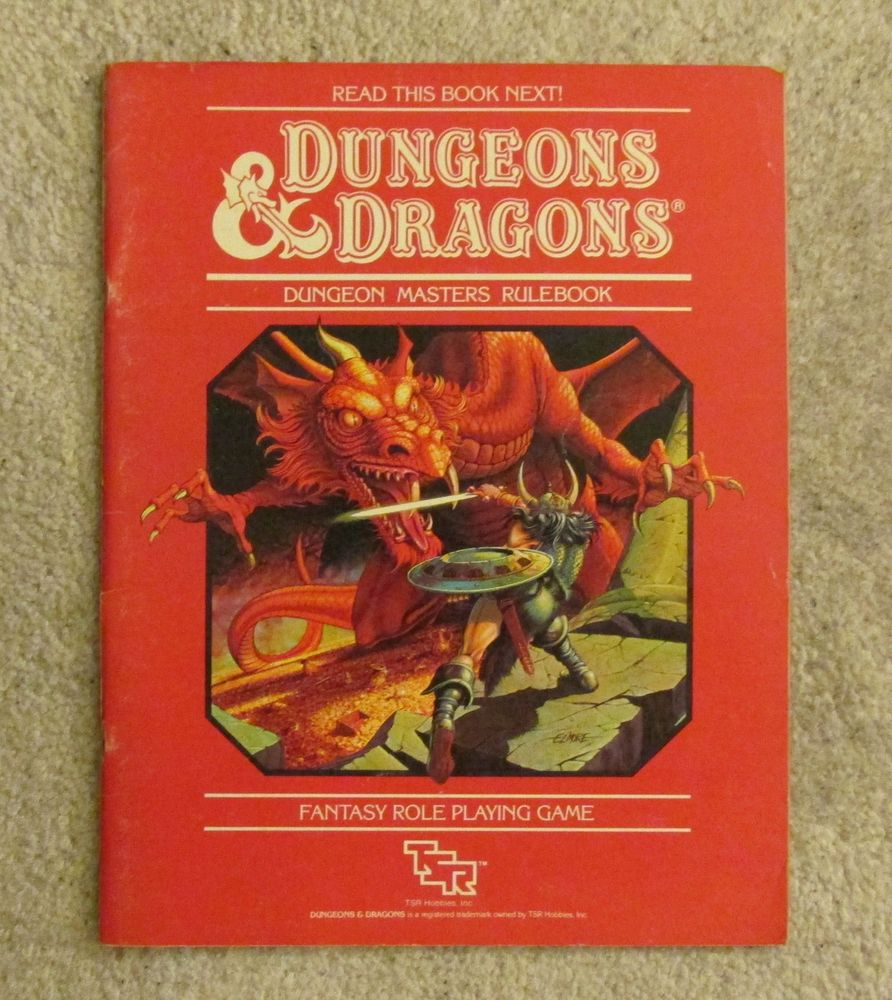
The very popular role playing game known as Dungeons and Dragons.
Where's the Beef
"Where's the beef?" is a catchphrase in the United States and Canada. The phrase originated as a slogan for the fast food chain Wendy's. Since then it has become an all-purpose phrase questioning the substance of an idea, event or product.
In the ad, titled "Fluffy Bun," actress Clara Peller receives a burger with a massive bun from a fictional competitor, which uses the slogan "Home of the Big Bun".
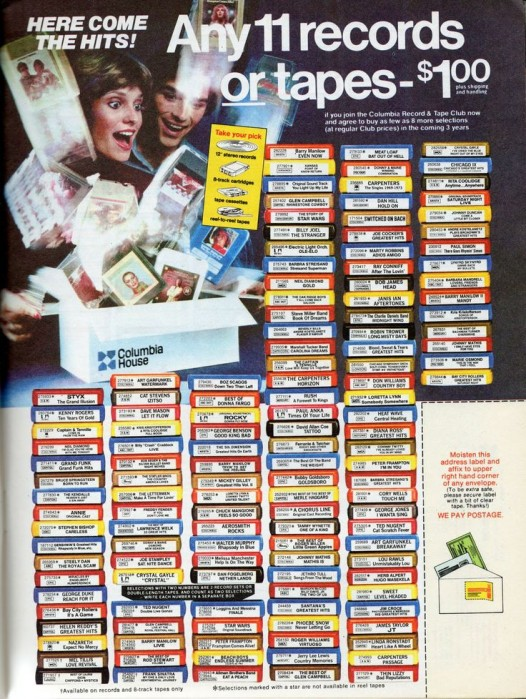
Record club advertisement. These advertisements became very popular in the United States, when all the radio stations were being bought up by mega media-companies. Suddenly all the music dried up to only about 100 “favorite ” songs out of a limited roster of 500 songs. To listen to anything else you needed to join a club. What a racket!
The so called “Silicon Valley” was just starting to take form. America was building up to finish the “Cold War” once and for all. We were going to out-produce those pesky Russian Communists until they would need to give up. (And, it worked!). The walls (figuratively and literally) came down.
Media was experimenting with CGI. Their early efforts were cautiously embraced. As a result, Max Headroom was terribly popular.
Computers
Computers were just leaving the hobby realm and entering the work force. Few people, aside from “nerds” owned a computer. The ones that were available were terribly expensive. For instance a “large capacity” hard drive would be 10MB and cost nearly $4000. The screen was monochrome and only presented text. It ran on MS DOS and utilized a “Dot Matrix” printer. Everything was off-white ABS plastic.
Max Headroom
Max Headroom is a fictional artificial intelligence (AI) character, known for his wit and stuttering, distorted, electronically sampled voice. He was introduced in early 1984. The character was created by George Stone, Annabel Jankel and Rocky Morton in the mid-1980s, and portrayed by Matt Frewer as "The World's first computer-generated TV host," although the computer-generated appearance was achieved with prosthetic makeup and hand-drawn backgrounds. Preparing the look for filming involved a four-and-a-half-hour session in make-up, which Frewer described as "grueling" and "not fun," likening it to "being on the inside of a giant tennis ball."
ABS
Interesting bit of trivia; the ABS material tended to age when exposed to UV light. Over time the white color plastic housings would turn into a disgusting dirty pee-yellow color. To extend the life of the product appearance, computer manufacturers would dye the plastic an off-white color. One of the secrets to selling old or used computers was to remove the plastic housings and then paint them bright white. People would snatch them up quickly, even though the electronics inside would be terribly obsolete. LOL.
CDROM’s had yet to be popular.
So people used “floppy disks” to store their work on. Music was available on records, 8-track tapes (Still available in the 1980’s, but their late 1970’s “hey days” were over.), and cassette tapes.
You could join “record clubs” that would send you a weekly catalog where you could purchase music on image alone. They would “pull” people in by offering them ten free tapes, then once locked in, you needed to make so many purchases a year. They also did this with books.
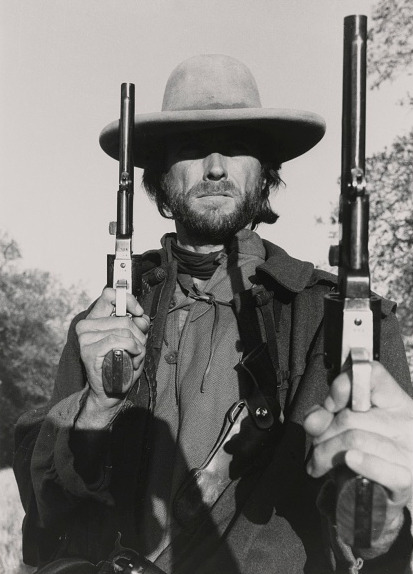
An iconic image in EVERY Design office. “Go ahead make one more change.” From Boston to Los Angles and every place in between, every design office, had this photo (and words) taped to the file cabinets or pinned onto the bulletin board.
Cordless telephones were just being made available. Each one was large, and typically had an extendable metal antenna that you would need to extend to obtain a half-decent signal. (Watch the movie “Risky Business” to see an example of this.)
This was the decade when the Nintendo NES came into our lives.
Indeed, many of us spent our time typing “cd games” into old IBM computers, loading some beeping game or another. But when you really think about it, that’s not much different from today. We still have consoles, we still have computer games, and we definitely still have beeping.
The games themselves are different, the graphics are different (obviously much, much better), but the environment is still very similar.
You sit on a chair. You play.
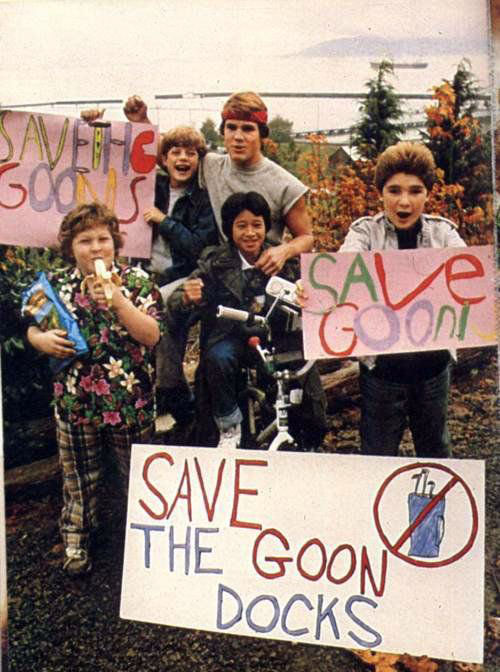
The Goonies. Mean old country-club Republican forces a nice middle-class white family on to the streets for corporate profits. Oh Hollywood!
“Must-see TV” (of course) meant “The Cosby Show”.
John Hughes movies were very popular and they were light, happy and full of 1980’s energy. How can you forget the movies “Sixteen Candles”, “Ferris Buellers Day Off”, “Weird Science”, or “Career Opportunities”.
Or what about John Cusack’s movies as “One Crazy Summer”, and “Better off Dead”. All are classics.
“I want my two dollars!”
-Johnny the Paperboy
While I would dress for work, I would often pass by kids going to school and I was constantly surprised with what they were wearing. Typical attire, in California, seemed to be neon span
(Of course, I was in the middle of extreme world-line switching at the time.)
Work office attire consisted of polyester everything. No one wore jeans or polo shirts. Men wore ties on collared shirts. Both the ties and the collars on the shirts tended to be wide. The colors were all tans and browns with a distinct movement towards pastels.
We all carried traditional briefcases. No one ever carried a backpack to work. If our bagged lunch would not fit inside the briefcase, we would carry it outside of it.
Office Coffee
All offices had a large tureen of coffee. Typically it was this huge metal cylinder with a spigot at the bottom. It would peculate coffee just like a conventional peculator.
These tureens held maybe five gallons of water, and used up a sizable portion of a can of coffee to make. The tureen would be on all working day. This was popular from my father’s generational period in the 1960’s thought the 70’s and 80’s up into the 1990’s.
Later on, into the middle 1990’s this was replaced by restaurant-style individual coffee pots cooking on burners. Typically offices would use either two or four burner units.
(Six burner units were rare outside of restaurants.) Unlike the tureens that were maintained by the company purchasing coffee and employees being responsible for making the coffee, the individual coffee pots typically came as part of a “service”.
A person come come to the office every two weeks to make sure the coffee is stocked up properly and the machine was in working order. The cost for this service was much higher than just the cost of a coffee and tureen.
This added convenience for the workers came at a price. When the coffee came out of the tureen, it was free to the workers. Let me repeat. Work office coffee was FREE for the office workers.
Fast forward to the Bill Clinton presidency; the age of greed.
No one ever took up collections to fund the coffee. That didn’t happen until much later in the 1990’s under President Bill Clinton. (It wasn’t his fault. He “inspired” everyone to go after money and become successful. Everyone was trying to “find an angle”.
At that time everyone was trying to get rich.
Companies were trying all sorts of techniques to improve profits. The President at that time inspired CEO’s, who then implemented various “programs” to improve profits.
I’m sure that there are a number of notable Dilbert cartoons on this subject.) In this environment, coffee became a “perk” that companies would use to “attract” talent and retain employees. Prior to that, it was an accepted norm. Everyone EXPECTED free coffee at work.
(That, alongside with free health plans with no co-pays and no deductions from one’s paycheck.)
I was in my twenties. The advantages of this was not appreciated until I was older. Ah, the generation before me had it so so good!
As an aside, as of 2018, coffee is still free to the office workers in the UK, Australia and China (that I know of). It’s only in the USA that companies treat their employees as farmed cattle to exploit. (Indeed, I hear Google let’s all their employees drink for free or at low reduced prices, as long as you are not white or male…LOL.)
“(I) Was working 75 to 84 hours a week for years till they laid me off ... they call it the American Dream but I was trying not to fuck up while exhausted and never believed it. ... just ensuring ppl don’t die in with planes crashing ... nobody gives a fuck especially the assholes called our representatives.”
-Vendetta Feb 6, 2018 3:29 AM Permalink
I owned a Beta-Max player.
In fact, I upgraded to the “super” Beta-Max player prior to purchasing the core unit. I guess that I was a little crazy about electronics at the time. However, I felt that buy purchasing the upgrade before I purchased the player gave me advantage.
I was correct. However, the advantage only lasted five years. Sigh.
I would be able to run off to the video store and rent a tape or two for the weekend. Over time, the high quality of Beta was replaced by the low-quality but low-cost VHS players. I like everyone else, eventually made the switch. Ah, it was a sad day indeed. For a while, unable to go to the store to rent videos, we would watch the old Beta tapes that we had at the house. Pickings were slim. We had “Roxanne” (Not to be confused with the television series of the same name.), “Spaced Invaders”, and “Soapdish”.

35mm film container. These came in metal tins with a screw on top and later, during the 1960’s came the plastic versions.
Life in the 1980’s
Carl’s Junior served food on wooden plates with a hot metal pan centered on it. They used real metal utensils, and a real serrated edge knife with a wooden handle. Drinks were provided in reusable brown plastic coffee cups, or tall plastic glasses for soda. A newspaper waited outside in a vending machine, and you could smoke in every restaurant. At that time, they still maintained a more-or-less hybrid existence; part restaurant / part fast food. (Sort of like Denny’s today.) Now, of course, they have devolved into just another fast food franchise.
Cross walk signs were in English. They did not use an array of LED diodes to form a picture of a standing or walking pedestrians. I guess that people then were able to read English, where today in the USA, you just are not ever sure.
Cell phones did not exist. Therefore, it was easy back then to isolate from the rest of the world, now you’re surrounded by world’s noise everywhere. Then you could isolate yourself. A quiet walk was for contemplation and enjoyment. It was possible.
Restaurants served a free tall glass of ice water with every meal, even for children. People used toothpicks and the ashtray on the table. (You could smoke in the restaurants as well, and buy your cigarettes out of a vending machine in the lobby.)
People smoked at their work desks. In fact, most desks were issued a clear ash tray when a new hire came on board. In the supply cabinet were usually a small stack of extra ash trays.
The meeting rooms all had big ash trays. Men carried lighters, as did women. Though, the small pack of lighters were still commonly available everywhere. Typically they would have the name and phone number of the establishment where they came from.
Some (typically Sales and Marketing types) would smoke cigars that would pollute the entire office. There was no such things as “designated smoking areas”. That was a creation of the Clinton administration to make work places safer (for the children), as well as to reduce the costs of insurance.
Thank you Mr. Clinton and your close buddies in the insurance agency.
How the children, who were too young to work, be affected by secondhand office-smoke is beyond me. But you know, there is no logic in politics. It is just nonsense spewed out to control the masses through fear and confusion.
Smoking
Most men have a vice — some pleasure in life that isn’t necessarily safe or healthy, but can be partaken of in moderation. For many gentlemen that’s tobacco, usually in the form of a cigar or pipe. Sure, you can walk into the tobacco shop and grab whatever you recognize or is cheapest. Or you can become a bonafide connoisseur, understanding why one tobacco variety differs from another, where each comes from, and those you truly like. Go down to the local tobacco shop and have the tobacconist show you the ropes. And of course you need hands-on study! Smoke (and sip — tobacco always pairs well with whiskey) until you find the gems that leave you relaxed and smiling at the end of the day.
For the Children
“For the children” was a catch phrase of the Clinton Administration. Yet, it just boggles the mind how children would be affected by workplace smoke. You cannot work until you are 16 years old.
The connection between the Clinton's and the insurance Agencies
Don’t believe me? Don’t know what I am referring? Think that I am just displacing blame? Do your homework. Know your history. The Clinton's, and by extension, the DNC were conjoined at the hip with insurance companies. Then they started to diversify. You can well consider the high costs of drugs today to be directly related to their need for multiple mansions.
They started increasing all their premiums dramatically, and the presidential administration helped them along magnificently with all kinds of supportive (pro-insurance) rules and regulations.
This manifested in many forms. One of which was the banning of smoking from the workplace. Another was the increase in insurance premiums. Yet another was the plethora of optional programs that people could implement to “lower” premiums. Until the insurance agencies obtained political power, they were just a simple business providing a basic service. Now, today, companies are fearful of legal actions and increase in costs if they fail to do A, B or implement C.
Indeed, a typical work desk at that time would have a dial or push button phone, a little tiny calendar (given away by insurance agencies and the like), a large page-by-page day planner that you could write your appointments on, an ash tray (for your cigarettes or cigars), a desk lamp with an adjustable neck (to improve upon the piss-poor fluorescent ceiling lighting), and a large desk mat.
Men who were “white collar” and who worked in the office typically wore business jackets. We would arrive and take off our hat and coat and sit at our desk wearing our white shirt (long or short sleeve) and tie.
This all started to change in the middle of the 1980’s and I pretty much welcomed the change to a more relaxed and informal working environment. Though, I did lament the loss of my coat rack.
However, with the relaxation of work dress standards came a tightening of work place behaviors.
During the Bill Clinton presidency, we watched the erosion of office worker respect. Culminating in cubicle work “farms” and impersonal bosses driven by Harvard MBA types. Watch the movie “Office Space” to see what I am referring to here.
It is not a coincidence that the Dilbert cartoon became so popular during this time.
“Office Space” is a 1999 American comedy film written and directed by Mike Judge. It satirizes the everyday work life of a typical mid-to-late-1990s software company, focusing on a handful of individuals fed up with their jobs.
The film's sympathetic depiction of ordinary IT workers garnered a cult following within that field, but it also addresses themes familiar to white-collar employees and the workforce in general. It was not a big success at the box office, making $12.2 million against a $10 million production budget. It was well received by critics and sold well on home video, and it has become a cult film.

During the 1980’s most Americans spoke English. This changed during the 1990’s when it became to absorb large numbers of assimilated immigrants. At that time, you did not need picturial images of people walking.
You could just spell the words “Walk”, and “Don’t Walk” and people would understand what you meant.
People flew flags on their porches during the fourth of July and did not worry about some social justice warrior or black lives matter radical burning their house down.
Additionally, the “American Stars and Bars” (Confederate flag), “Don’t tread on me”, State flags, and MIA (Vietnam missing in action) flags could be flown as well.
In my ENTIRE life, I have NEVER seen a “rainbow”, Antifa, or BLM flag flown on someone’s porch.
I guess, I need to be in “Lala land” (Hollywood) or Wall Street and mingle with the face of the oligarchy (Hillary Clinton, Harvey Weinstein, and George Soros) to experience that reality.
The movies of that time were actually (in my mind) pretty awesome. “Sixteen Candles” was pretty typical for the time. I preferred comedies as they were “up beat” and positive with a nice happy ending.
You go to a movie, and watch it.
Then afterwards, you go out for a “stuffed pizza” and a pitcher of beer. At the time, I was terribly fond of olive, mushroom and pork thick crust pizza. Afterwards we would go and get a butterscotch milkshake on the way home. We were regulars at movie theaters. They were pretty cheap back then. Two people could go out and watch a movie and have a large pizza and a pitcher of beer for under $10. Movies that we saw in the theater included “Better off Dead”, “Hot Dog the movie”, “Lost Boys” and “One Crazy Summer”.
“As someone born in '91, I've been brushing up on my '80s movies, damn would that have been a good time to be alive.”
Even McDonalds had tiny little disposable aluminum cigarette trays. Republicans used the color blue, and Democrats used the color red.
Reading the morning newspaper was a popular pastime and every weekend restaurants would share multiple copies of the Sunday editions of the paper to various patrons to read. Five dollars would fill your gas tank and it would last (almost) all week. Drive-ins were still very popular, and malls were everywhere. A price for two to watch a movie was under $5 on a Friday night. Yes. It was, a very… very different time indeed.
Democrats were Red
Democrats Used the Color Red
Globally, long-standing traditions dictate which colors represent specific political camps. Here, the assignment of red to the Republicans and blue to the Democrats is not a reflection of each group's ideology. Rather, this color designation is the supposed result of a collective decision made by major media networks.
The general public had no say in the matter. Neither the Republican nor the Democratic Party has ever officially chosen a color to represent its organization.
Up until former President Bill Clinton came into office, the colors were “more or less” defined as Blue for Republicans and Red for Democrats.
Today, the official (rewriting of history) explanation is that the advent of color technology, television networks created their own identifying colors, often alternating with each new election to avoid any appearance of favoritism.
It is an explanation that sounds plausible, but this is not really true.
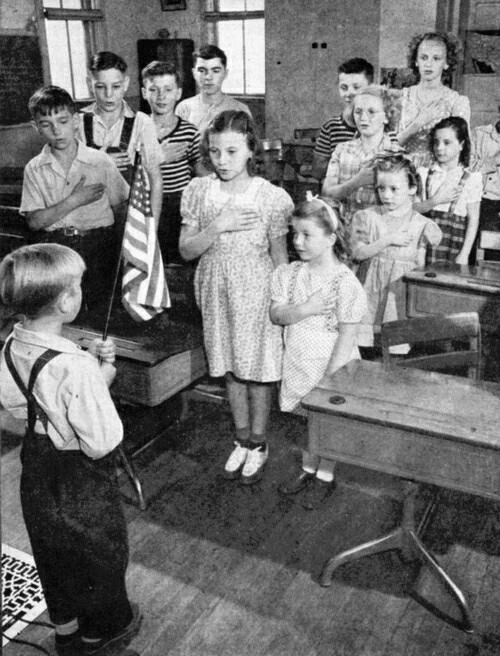
Everyone recited the pledge of allegiance at the start of every class, at the start of every game, at the start of every school event, at the start of every cub scout meeting, and at the start of every Rotary Meeting. Bet you didn’t know that? The oligarchy narrative falls apart when history becomes involved.
I grew up during the “Cold War”. During this time, the political colors were set and established.
I do not care what colors were used in the turn or the century, or during the Spanish-American war. Or what colors were preferred during the revolutionary war. All that is academic babble.
My concern, especially in regards to this narrative, was what the colors were during the 1960’s through the 1990’s. This was the time that I grew up in.
The United States was smack dab n the middle of a "cold war" with two communist nations; Russia and China. Both of whom used RED for their socialist ideals.
Red = Soviet Union (Communist)
Red = Red Chinese (Communist)
Blue = Liberty and Freedom. As were the fifty stars (states) on the flag.
The simple truth was that for the most part during the 1960’s, 1970’s and into the 1980’s, Republicans were blue and democrats were red at the top and blue on the bottom.
(Oh yes, there were exceptions. However, the reader need not be fooled. The largest quantities of the most popular election buttons for Republicans were blue color. In fact, when I went to college, I could not find any that were a different color, and I looked!)
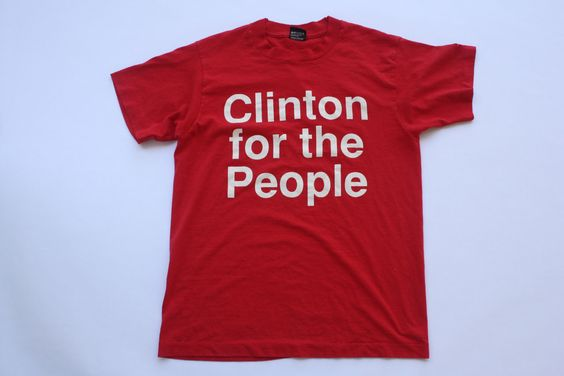
Vintage Bill Clinton and his Democrat party campaign tee-shirt. Red is the color of the “People’s revolution”. So it is very fitting that Democrat Bill Clinton would have a nice red tee-shirt for his political party.
Don’t believe me? Go to an antique store and look for Ronald Reagan election pins and Jimmy Carter pins. You simply cannot find red color Regan, Bush Sr, or Bush Jr election pins. At best you might find red and blue, but no only-red buttons. Neither can you find (too many) blue Jimmy Carter pins either. There are some, but they aren’t common. Far more likely is finding green color Jimmy Carter buttons. Why is this the case?
Why, you might ask.
Well, the answer is really quite simple. During the “cold war”, red was the color of communism. Both for communist Russia and for communist China. Conservatives then, as today, hate communism as it is the opposite of individual freedom. It is a collective society.

Reagan and Bush Republican tee-shirt from 1981. The Republican color was blue.
During the cold war, red was the color of communism. Red was the color of communist China. (Note the communist Chinese flag color.) Red was the color of the soviet union. (Note the color of the soviet union flag before the breakup.) Blue was the color of freedom and liberty.
However, a social collective society has been the bedrock of the Democrat party for most of the century so the Democrats never had a problem with the color red. That is why that during the cold war, most Democrats wore Red and most Republicans wore blue.
It is truly disingenuous for revisionist historians to use time periods around the time of the civil war to reflect the mindset of Americans during the cold war time period. Or the limited small quantities of specialty buttons that were produced for limited market segments to reflect the vast bulk of the overriding color scheme.
We are discussing the cold war, and it is this time period that I am discussing here. The reader must remember and must be reminded that the Democrats during this time period, for the most part, supported the efforts of Mao and his revisionist climate in China; totally ignorant of the mass killings.
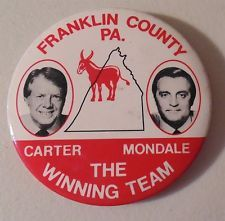
They supported the “workers paradise” in Russia , though they officially deplored the military buildup. During the 1970’s red was the color of Democrats. Blue was the color of Republicans. Go to a antique shop or go online and purchase a Reagan/Bush campaign pin.
Read the articles in the 1972 Mechanics Illustrated magazines, and Men’s Adventure magazines of the 1960’s. Do not use the Internet to check your facts. The internet is all politically manipulated. The Internet is a blackboard that is continually being erased and rewritten. Go to a old book store and read the articles and look at the advertisements yourself. Check for yourself. Yes, there were exceptions. However, for the vast bulk of the time during the 1970’s this was the case.)
Truthfully, up until the year 2000, it was never formally established what the colors would be, though it was clearly favored that Republicans were blue and Democrats were red; forcing then (famous) political commentator Rush Limbaugh to remark; “Has anyone else noted that the networks switched colors?”
Thus, in 2000 for the first time, all the major news outlets agreed to use red for the Republican Party and blue for the Democratic Party. A switching of the political colors. I personally believe that this switch was mutually approved by both political parties, while it was initiated by the Democrat party for reasons unclear.
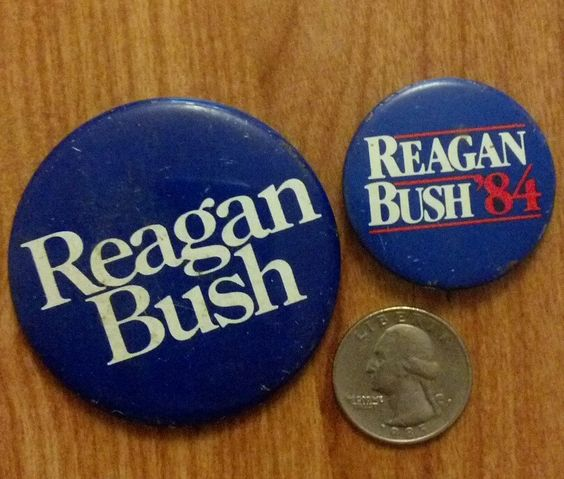
Reagan-Bush campaign buttons. A nice Republican blue color. Too bad that the oligarchy and their media has decided to rewrite history.
My personal opinion is that the Democrat party embraced the current populist trends at the time; they adopted the New World Order (NWO).
It is the overriding policy of what we call today “the globalist elite”. The color for this one-world-government was to be blue. As such the EU adopted blue as their unifying color. The color of the UN was light blue, and President Clinton (D) had all the Army insignia changed to match the baby blue color of the UN troops.
It is only speculation on my part, but I sincerely believe that the adoption of the color blue for the Democrat party had more to do with a future agenda of a global nature than any localized nationalist policy platform. The Democrats favor a global social world government. There is nothing good or bad about it. That is just the way it is.
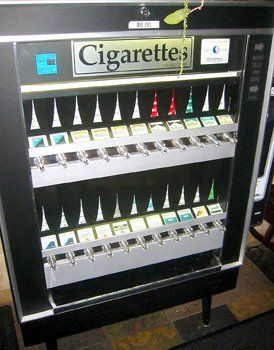
Cigarette Vending Machine from the 1970’s and the 1980’s. Ah, back then you had the freedom to purchase cigarettes out of a vending machine. Ah, the good old days, when Americans were free.
“The 80s was a PC free culture for the most part. You can't have an open and honest discussion today because people will be more concerned about "how" their words will be misinterpreted vs. the content of what they are saying.”
— MAJ L. Nicholas Smith
“Saturday morning cartoons, Saturday afternoon cartoons, MTV with actual MUSIC, music with ACTUAL MUSIC, Bo Jackson, Wayne Gretzky, Hershel Walker, Empire Strikes Back, Return of the Jedi, Commando, Rambo, The A-Team, Air Wolf, Playing outside, free speech without the fear of being branded by some pussy who is offended by it, Yep pretty much to me, born in the mid 70's the 80's were the best decade ever.”
— SPC Andrew Griffin
“I miss the greatest president in my lifetime, Ronald Reagan, and the pride he instilled in America.”
— MSgt (Join to see)
Yes. I too miss the ability to practice “free speech” and the Bill of Rights. I guess ol’ Bush and Obama pretty much ended all of that. (Sigh.)
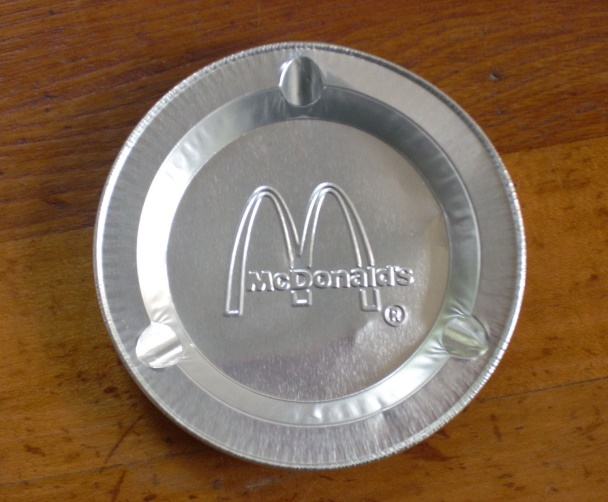
Before the Democrats, led by Bill Clinton banned smoking, you could smoke everywhere in the Untied States. Here is a (once) very common disposable smoking ash tray from McDonalds.
Yes, the Progressive Democrat Liberals have pretty much fucked the nation all up. (Don’t go PC on me. They did actually FUCK it all up.) It’s not just me saying this from the point of view of an American, but from the point of view from someone in MAJestic.
Service to Self Demons
Jesus-H-Christ. If you the reader are offended, then put this fucking manuscript down and walk away. The Democrats fucking strip-mined American culture. They made debauchery and looting of Americans a national pastime. (Not just Democrats, of course.
There are many socialist-inspired politicians who became RINO Republicans so that they could have a comfortable life through lying and cheating their constituents.)
How in the heck can someone become a billionaire without hurting another in some way?
It’s not just Democrats, but many Republicans as well. So I will repeat the question. How, in a reality balanced upon individual thoughts that manifest into actions, can a person become a billionaire without negatively affecting others? How is it possible? How?
Ponder that profound statement for a second.
If they weren’t so busy trying to manipulate others, alter the lifestyle and time progression of others, fixated on carnal desires of sex, sloth, and the greed of money how could they possible accumulate wealth? The accumulation of wealth is not a given.
It is NOT an event that manifests for a handful of “lucky” people who happen to be at the “right place at the right time”.
Those are simplistic childish ideas and concepts. They are rooted in a belief that the physical is all that there is.
It is one man (or woman) for themselves, and if they are aggressive enough, and have the right opportunities, and some skill in manipulation, they can take from others. They can take. They can take, and take, and take.
If there is one thing that the reader can get from <my words of wisdom> is that the universe does not work that way. Yes, you can alter your reality by thought. Yes, you can acquire wealth, and comfort and desirable relationships. Yet, everything comes at a cost. To acquire a large volume of “stuff” will have a corresponding large “cost” elsewhere. Other people will be affected.
This is not politics. Do not be so naive that a socialist model is heavenly derived. It isn’t. In fact, it is a manipulative trick used by the skillful to fleece the ignorant. There are no easy answers and pristine solutions.
Every decision, thought and action comes at a cost. Some people do not care what the costs are for their desires and their actions. They only want the end results to manifest.
Indeed. Oh…my…The 1980’s were a time of expression and freedom. Those of us who lived through that time do remember what free speech was.
Ah “free speech”. Don’t take it from me alone. Here’s some opinions from Reddit “What do you miss about the 1980s” we have these jewels…
“Kids being able to walk to the park without the cops being called. They also were immersed in social situations where things were scary, uncertain, and difficult allowing them to not have a nervous breakdown opening a bank account or saw a Halloween costume they didn't care for.”
- savemejebus0
“No cellphone, no problem.
It was nice to be able to leave a note at home with 'went to run some errands'. Whoever came home and saw that would have to wait for you to return. If the phone at home rang and they answered, they would take a message or the answering machine would.
You could leave, go do what you wanted and not have to explain yourself in the moment as to what you're actuality doing.
If you wanted a private conversation, you went to a payphone, especially one with the long cord so you could sit in your car and roll the window up.
It was bliss! Now you have your digital GPS tracking leash with you at all times, either volunteering everything you do on social media, replying to every request for your location and if you don't reply, you're chastised for it.
I miss the days of being able to just get lost.
Now your berated for 'turning your leash off'. Where were you, who were you with, why didn't you answer, what are you trying to hide, I'm not important enough to reply to, you could have been dead, had a car accident, kidnapped, cheating and so on.
You have to have lived in that time to understand it. If you didn't, you don't realize how bliss it was to be able to get lost on purpose. Turning off your phone is like ignoring stomach cancer.”
— Ennion
MTV actually played music videos.
It wasn’t political, and staffed with urban ghetto blacks. The same was true with the NFL. They played football, and the networks didn’t run (what can best be described as) a negro version of a KKK rally during every single friggin’ game.
We had endured the horrific 1970’s where President Nixon (R) acted as a King. We were very jaded by the resultant investigation of the wiretapping of phones.
Oh, how silly that looks today with 24-7 mass surveillance now, and the behavior of Eric Holder (DOJ) and Hillary Clinton. We saw what happens when a good-honest man; President Carter (D) (who was ineffectual as a president) becomes president.
Ronald Reagan
We, like the rest of the nation, were ready for a real change, and we got it. We lived during the presidency of Ronald Reagan (R). There will be many who have their own ideas about this time. But I will tell it through the eyes that lived through that time.
Say what you will about “Ronald Ray-Gun” and the 1980’s, but the truth was that for me, it was a time of hope, and of adventure.
Ronald Ray-Gun
An enduring nick-name for the president during that time period. And important, as we really understand now. For not very well known is exactly how frighteningly close the world came to global thermonuclear war. Historical revisionists seem to conveniently forgotten the dangers of that time.
Thanks to a February 1990 report (National Security Archive Electronic Briefing Book No. 533 previously classified "TOP SECRET UMBRA GAMMA WNINTEL NOFORN NOCONTRACT ORCON") published by the National Security Archive at George Washington University after a 12-year Freedom of Information Act battle. The US and Soviets were dangerously close to going to war in November 1983, the bombshell report found, and the Cold War-era US national-security apparatus missed many warning signs.
That 1983 "war scare" was spurred by a large-scale US military exercise in Eastern Europe called “Able Archer”. It was because of this military operation that the Soviets apparently actually believed that it was part of allied preparation for a real war. (In part due to the very nature of Ronald Reagan’s public comments to that effect.)
The Soviet military mobilized in response.
US-Soviet relations had definitely plunged in the early 1980s, but since then experts have debated how close the US and Soviets had come to the abyss during Able Archer.
Read it here and be horrified; http://nsarchive.gwu.edu/nukevault/ebb533-The-Able-Archer-War-Scare-Declassified-PFIAB-Report-Released/#_ftn3 .
Of course, we know how how all this was avoided, and how the USA and Russia became friends again. However, the reader must realize the real and stark truth; we are now living in an alternate time line spawned from that event.
A time line, that switched in part, through significant extraterrestrial intervention by the <redacted>. (More detailed information about alternative world lines are addressed later on in the blog.)
Yes. Ronald Reagan may have had this nickname, but the truth is that he turned his back on the neoconservatives.
He fired them, and had some of them prosecuted, and when his administration was free of their evil influence (for the most part, though other neocons such as Orin Hatch continued to promote efforts to create global nuclear conflagration), and President Reagan negotiated the end of the Cold War with Soviet President Gorbachev.
The history is clear; the military/security complex, the CIA, and the neocons were very much against ending the Cold War as their budgets, power, and ideology were threatened by the prospect of peace between the two nuclear superpowers.
Everyone was optimistic. But you will not see that in any revisionist history books.
Ah, the rewriting of the past. Here’s El Rushbo on the rewriting of that decade by President Obama and his minions.
“President Obama micromanages the economy into the ground and tells the American people that our better days are behind us. He says the great days of America’s past were not really legitimate. They were built on phony policies, trickle-down economics from the Reagans. We stole resources from other nations around the world. Our superpower status was not deserved. We now must manage the decline. And I, Barack Hussein Obama, am the smartest guy in the world to manage the decline of the United States and its economy.
His replacement liberates the economy, unleashes the United States economy to the point in under a year it is growing at twice the rate it ever grew under Barack Obama.
And yet we’re told Obama’s brilliant, he’s so smart, we can’t even stay in the same room with him. He’s so brilliant, we can’t keep up with the guy. He’s so brilliant, all we can do is bow at his feet and try not to be blinded by the light reflecting off him. Donald Trump is silly. He’s insane. He’s obsessed. His unfit. We need psychiatrists examining him. We need the 25th Amendment.”
The Iranians released the American embassy hostages, a large American “freedom” space station was going to be built. Americans were returning to the Moon and then Mars! (Plans later killed by President Obama (D). President Obama said that going to the Moon wasn’t worth it. We were there already. So we will go to Mars instead, he said. Then he killed Mars exploration because it was too expensive, he said.
Then he goes around and gives $7 billion dollars to South Africa and $150 billion dollars to Iran. WTF? What world-line am I on? Jesus… maybe it’s time to get off.)
Release of Hostages
Fifty-two American diplomats and citizens were held hostage for 444 days (November 4, 1979, to January 20, 1981), after a group of Iranian students, belonging to the Muslim Student Followers of the Imam's Line, who were supporting the Iranian Revolution, took over the U.S. Embassy in Tehran.
Space station Freedom
Space Station Freedom was a NASA project to construct a permanently manned Earth-orbiting space station in the 1980s. Although approved by then-president Ronald Reagan and announced in the 1984 State of the Union Address, Freedom was never constructed or completed as originally designed thanks to the efforts of Bill Clinton, and after several cutbacks, the project evolved into the International Space Station program.
1980’s Culture
Russia was tearing down the wall in Germany. Companies began hiring again, and everyone was hiring everywhere. MDMA was discovered, and the youth of the country learned to emote to each other.
LSD was still being used, and everyone was questioning the roles that society fostered upon them.
Madonna had released her first of many albums, and she wasn’t such an aggressive asshole. Pastels were popular and everyone was dancing to Wang Chung.
Michael Jackson was only a singer, and yet had to “Beat It”.
Tear Down this Wall.
" Tear down this wall! " was the challenge issued by United States President Ronald Reagan to Soviet Union leader Mikhail Gorbachev to destroy the Berlin Wall, in a speech at the Brandenburg Gate near the Berlin Wall on June 12, 1987, commemorating the 750th anniversary of Berlin.
MDMA
MDMA (3, 4-methylenedioxy-N-methylamphetamine) is an empathogenic drug of the phenethylamine and amphetamine classes of drugs. MDMA has become widely known as "ecstasy" (shortened to "E", "X", or "XTC"), usually referring to its street form, although this term may also include the presence of possible adulterants.
LSD
Lysergic acid diethylamide, abbreviated LSD or LSD-25, also known as lysergide (INN) and colloquially as acid, is a semisynthetic psychedelic drug of the ergoline family, well known for its psychological effects which can include altered thinking processes, closed- and open-eye visuals, synesthesia, an altered sense of time and spiritual experiences, as well as for its key role in 1960s counterculture. It is used mainly as an entheogen, recreational drug, and as an agent in psychedelic therapy. LSD is non-addictive, is not known to cause brain damage, and has extremely low toxicity relative to dose. (Though the DOJ would beg to differ on this.)
Madonna
Madonna is an American singer-songwriter, actress, and businesswoman. She has been one of the most prominent cultural icons for over three decades. As such, she has achieved an unprecedented level of power and control for a woman in the entertainment industry. She attained immense popularity by pushing the boundaries of lyrical content in mainstream popular music and imagery in her music videos, which became a fixture on MTV. Madonna is known for continuously reinventing both her music and image, and for retaining a standard of autonomy within the recording industry.
Pastel interior design
Pastel colored interior design, inspired by a retro art-deco movement that was popular at that time.
Wang Chung
Wang Chung are an English new wave musical group formed in 1980. The name Wang Chung means "yellow bell" in Mandarin Chinese, and is the first note in the Chinese classical music scale. The group found their greatest success in the United States, with five Top 40 hits in the US, all charting between 1983 and 1987, including "Dance Hall Days" (No. 16 in the summer of 1984), "Everybody Have Fun Tonight" (No. 2 in 1986) and "Let's Go!" (No. 9 in 1987). In fact, the reader should note that many stereo stores, and clothing stores at this time, played his music endlessly during this time period.
Beat It
"Beat It" is a song written and performed by American singer Michael Jackson from his sixth solo album, Thriller (1982). The song was produced by Quincy Jones together with Jackson. Following the successful chart performances of the Thriller singles "The Girl Is Mine" and "Billie Jean", "Beat It" was released on February 14, 1983 as the album's third single. The song is also notable for its famous video, which featured Jackson bringing two gangs together through the power of music and dance.
It was a magical time, a heady time of life and adventure. As a result, we experienced both the good and bad that life had to offer us.
A life lived in fear is a life not lived
Everyone lives in fear. Everyone, and I do mean EVERYONE, has warned us along the way to watch out for crazy people and to be weary of strangers, but I’ve found that to be largely unnecessary.
They were just warning us out of their own fears of the unknown.
Most of the people who threatened us were well-established, locals who saw us as a threat to their calm and stable way of life.
While we did meet some very dangerous people on the road, we were (typically) able to avoid them because, I think, we were just far too innocent and their hearts weren’t so cold as to corrupt the good that shined through our hearts.
Of course, we did meet some crazy and even evil people. That is what happens when you step outside the walls of your safe enclave. However, we were too kind, and too nice for anyone to really do anything bad to us. But there were some close calls.
Truthfully, we found an equal proportion of bad people scattered about the population.
Some were obvious, and behaved stereotypically bad. While others looked like the pinnacle of respectability; and held important positions in the church, society and government. Yet, they were evil incarnate.
Yes, and we did meet some very bad people on the road. There were times when we could have been hurt dangerously, but we did not permit that to happen. When a person ventures out, it is natural to experience both the good and the bad in people.
Yes, we had SOME bad experiences. You experience life when you travel; both the good and the bad. But, most of our experiences were positive.
The vast, VAST, majorities of people in this country are good and were willing to help out however they could.
Whether it’s by buying a meal or by letting you sleep in their house or at their business, people are more than willing to accommodate you in any way they can when they see you struggling. I figured this would be the case, but the extent is surprising to me, nonetheless.
Americans are good people. Most have kind hearts. They are kind and understanding for the most part.
The only times that I’ve seen someone who wanted to help me out but couldn’t are when an individual has to abide by a chain of command. This includes almost all government services, and hierarchical organizations.
Sometimes it was a social service agency, that wouldn’t accept people without children, at other times it was a Church that wouldn’t help us (though, the woman behind the desk gave us $40 out of her own wallet).
It was a lady at a gas station who wanted to let us sleep out behind their business but the company wouldn’t allow it. Or, a stranger who put an envelope on our front window contained $40 with the words ‘God bless you’.
These people were the angels that held our hands along the way. These people did so in secret and told no one what they did. These are the “real” Christians who tried to make a good and positive difference in our lives, even though they knew nothing at all about us.
In short, people who are free to help, will. While those who are forbidden from helping still wish they could but are unable to.
There are “Christians” and then there are Christians.
Some are good and some not so. We found that Baptists and Methodists were very helpful. So were Catholics. Lutherans and 7th Day Adventists; not so much.
In general; charismatic Christian organizations were the most welcoming. With Assemblies of God being, by and large, the most accepting.
(Now, in the year 2016, the political landscape has changed substantially. President Obama openly states that Islam has been the very fabric of American culture.
What complete nonsense!
We traveled the entire country and never, ever saw a mosque or met someone of the Islamic faith.
Those that one sees today are fresh arrivals, usually less than ten years as a citizen. At that time, the vast bulk of religions in the USA were of Christian denomination. Do not let the media rewrite history. I say again; Do not let the media rewrite history.)
Faith
This is the continuation of E106-1 Lost and Wild Adventures > Faith
You know what?
We learned a lot about life. And, instead of comparing yourself to others, you need to stop. Just stop thinking about other people and what they think about you. You need to think about you, and the individual path that YOU are on.
You, and everyone else in the world, needs to stop judging themselves by the standards set by media, government, religion, social groups, and instead think of only judging ourselves.
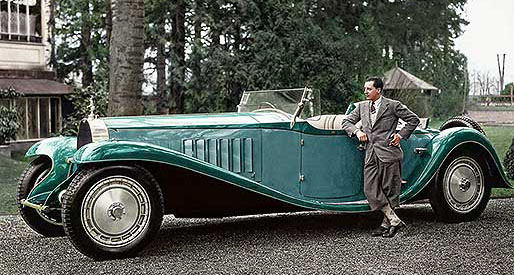
There will always be those who are richer or more prosperous. There is no use judging others.
Stop judging others.
Everyone has their own lives. What we see is the shadows of their existence as it pertains to our reality. So we need not get too worked up about how they live their lives.
When I carry on and rant about some SWJ or some corrupt individual in power, it is not because I am judging them in a comparative manner. I am relating my emotions related to that individual.
_Most people make judgments comparatively. That is to say; “If it were me, I would not do what they did…”
That is different than getting angry with a person because he stole all of your grandmother’s life savings. The reader should understand that there are different ways of making judgments. These ways differ in thought intention. Unless you can control your thoughts, you will never be able to control your life.
How other people live their lives are not our business.
Though it is if it directly affects us. Indeed, there are many kinds of people on this planet, and many ways to live your life. Other people live other lives. Some have harsher lives, and some have easier lives.
Some have terrible lives, but they look like their lives are easy and nice. Others have what appear to be absolutely horrid lives, and yet they are fine and happy. You cannot make a comparison at all.
A person, and their true situation, is NEVER obvious to the public.
Everyone on this planet is living a complex life that has invisible chains and entanglements far in excess than what we alone can bear.
It might look like they are doing well. It might appear that they have a nice job, and a new car, and a beautiful wife. It might appear that they are very successful. But the amount of money that a person has is not a measure of success.
The appearance that a person has, or the clothes they wear are also not a sign of success. They are only characteristics that provide the illusion of success.

Life can end quickly. Pay attention to how you run your life.
Don’t judge them because they look rich. Don’t judge them because they seem poor. Don’t judge them because they seem promiscuous, or engage in vices. It’s no one’s business but theirs.
We must start to live our own lives. Not vicariously through the lives of others.
You’ve got to accept yourself; who you are and what you are.
It does not matter what has happened in your past. You are not what you have done or experienced. You are not what is valued by the employer who hired you. Your value is not your job. Your value is determined by only one person, and that is yourself.
You have to accept it, with all the good and bad that exist inside you.
You’ve got wake up at five in the morning, brew some deep black coffee, and listen to the birds singing their sweet song in the glowing darkness of the new dawn.
You’ve got to sit next to the cute girl at the train station who’s reading your favorite book and start a conversation with her.
You’ve got to go to that local attraction that you’ve been meaning to visit but never got the chance to see. You’ve got to start doing things, and stop thinking about them. You’ve got to come home after a bad day and burn your skin from a shower until it is lobster red.
Then cool down with a quick cool blast. Then you’ve got to wash all your sheets until they smell of lemon detergent you bought for four dollars at the local grocery store. You’ve got to play with the local dogs and cats in the neighborhood and give them a treat or two.
You’ve got to live life.
Go to that Attraction
I lived in Boston for almost a decade and never visited Salem. It’s a great historical place, but I just felt that I could go out and visit it some other time later on. Instead, I just raked my leaves. I just would get two cords of wood for the fireplace delivered by pickup truck. I would go about my daily routine and eat at the local diner. I did not go out and see what was available right in front of me.
I wasted an opportunity.
Make it a point to better the world around you. Smile more. Complement people more. Praise people, and complement a stranger that you like their hair or dress. Be helpful. Be nice. Be kind. You have this physical life to live; live it well.
Live your life well.
“…She calls me Raymond, and that’s all right with me.”
-Brett Eldredge, “She calls me Raymond”.
You, yes you, have got to stop taking everything so goddam personally. You are not the moon kissing the black-black sky. You are not some “lone wolf” who is without a pack to travel with. We are all interconnected. We all need each other.
You’ve got to compliment someone. You’ve got to help the old lady with her laundry at the laundry-mat. You have to talk to people at art fairs and tell them that their eyes remind you of green swimming pools in mid-July.
Am I making my point?
You have got to complement someone. Tell the girl that she looks good in that dress, whether she does or not. You have to tell that person who has a smile that their smile just made your day. You’ve got to help others; praise others; and do something with your life.
You’ve got to stop letting yourself get upset about things that won’t matter in two years.
You’ve got to sleep in on Saturday mornings and wake yourself up early on Sunday. You’ve got to stop worrying about what you’re going to tell her when she finds out. You’ve got to stop over thinking why he stopped caring about you over six months ago.
You’ve got to stop asking everyone for their opinions. You have to stop trying to control things…
You have got to be you. Be the best you that you can be, and forget what everyone else thinks.
You’ve got to love yourself. You have to live your destiny. You have to do what you need to do, and not what other people thing you ought to do. You must follow your heart and live life like it was the most precious thing in the world.
You must enjoy life, embrace life, grab life with both hands and gulp the golden nectar down your throat in sloppy splashes of foam. Then wipe your face off with both hands and smile a big toothy smile.
Anything less is a disservice.
“They stood at the top to a little rise.
"Feel," said Driscoll, his hands and arms out loosely, "Remember how you used to run when you were it kid, and how the wind felt, Like feathers on your arms, You ran and thought any minute you'd fly, but you never quite did."
The men stood remembering, there was a smell of pollen and new rain drying upon a million grass blades.
Driscoll gave a little run. "Feel it, by God, the wind. You know, we never have really flown by ourselves. We have to sit inside tons of metal, away from flying, really. We've never flown like birds fly, to themselves, Wouldn't it be nice to, put your arms out like this —" He extended his arms, "And run." He ran ahead of them, laughing out his idiocy. "And fly!" he cried.
He flew.”
-Here there be Tygers
Full reprint of this fine Ray Bradbury story.
Social Media
“A human being should be able to change a diaper, plan an invasion, butcher a hog, conn a ship, design a building, write a sonnet, balance accounts, build a wall, set a bone, comfort the dying, take orders, give orders, cooperate, act alone, solve equations, analyze a new problem, pitch manure, program a computer, cook a tasty meal, fight efficiently, die gallantly. Specialization is for insects.”
-“Time Enough For Love”, by Robert A Heinlein
When I grew up there wasn’t any kind of social media. None. There was no Facebook, QQ, Snapchat, or anything like that. There were no “mobile applications” because there were no mobile phones.
Our entertainment was limited to friends, movies, outdoor activities, and television. No one had a cell phone, a PDA, or laptop.
Software games were simplistic pixilated arcade machines that resided in movie theater lobbies or game rooms. For fun, if we were alone; we watched television. If we were with friends, we would participate in some kind of outdoor activity.
However, all of this has since changed.
Since the late 1990’s social media has hit America with a great ferocity.
This is fine, and has it’s benefits, but one of the draw backs is that a person who has always lived in a world where social media dominates the culture cannot understand what it was like before social media existed.
For them, it is very difficult to understand why people acted and behaved as we all did in the 1980’s and 1990’s.
When I was in my 20’s we did something that was known as “hanging out”. Rather than stay inside the house and watch television, or go to a bar, we would just go “hang out”. This may or may not have included drinking. It may or may not included drug use.
It may or may not included doing a sport or outside activity. It basically involved being with friends together.
Examples of this (seemingly or not) boring activity can be seen in the movie “Dazed and Confused”, or in the music video “First Kiss” by Kid Rock. Much of that time was involved in cruising the streets in a car of pickup. Often we were in some sort of inebriated state.
Truthfully, the best movie ever made regarding what it was like in my high school, during my Senior year was the movie “Dazed and Confused”.
While it took place in the upper great lakes region, I can affirm that it adequately and truthfully represented what my final year in high school was like in Western Pennsylvania. We kids…well, we all “hung out”.
Sadly, I really don’t see that happening any more.
Instead, I see people glued to their smart phone, and playing games… even when they walk! I can go to a restaurant, and the entire table is playing on their phones and no one is talking. What the hell is going on?
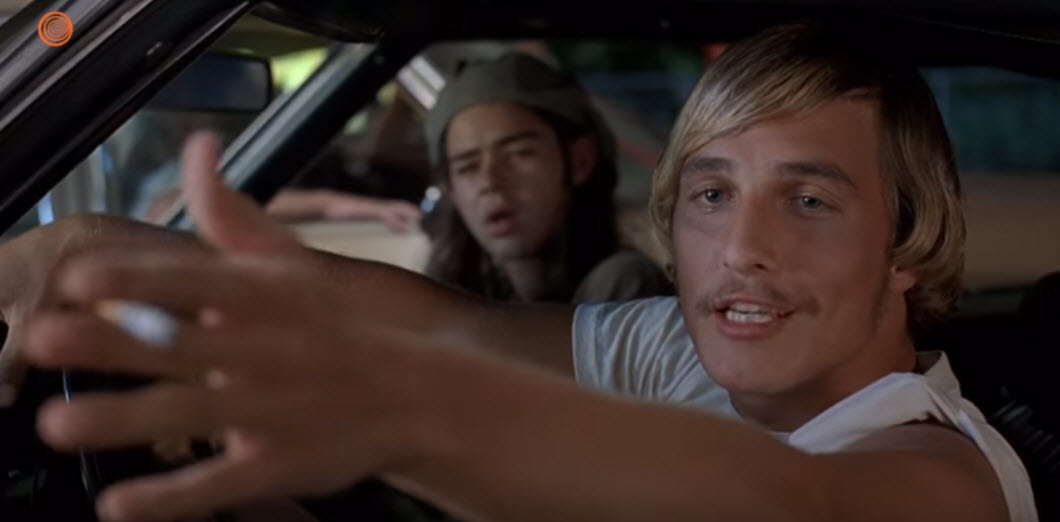
My generation worked and spent the money on our cars. I had a orange GTO and crused the streets in it with my stoner friends. LOL.
Heck, back in those days (before I got married) and well before I entered the US Navy, life was all about hanging out, being with friends, and “chillin’”.
Some of the iconic scenes in the movie were so atypical that a failure to reproduce them here would be a great disservice to the reader.
Ah…
But I digress. Social structure back in my generation was quite different than what it is today. We had friends and spent time with them.
Instead of going out to Starbucks any paying $10 for a caramel latte, and then sit down and use the WiFi to check our Facebook account, we would do something quite different.
Indeed, we would spend the $10 on a keg of beer, or maybe two, and a shit load of “munchies” (food) and enough gas to drive to California and back. (Yeah. Prices were much cheaper then.)
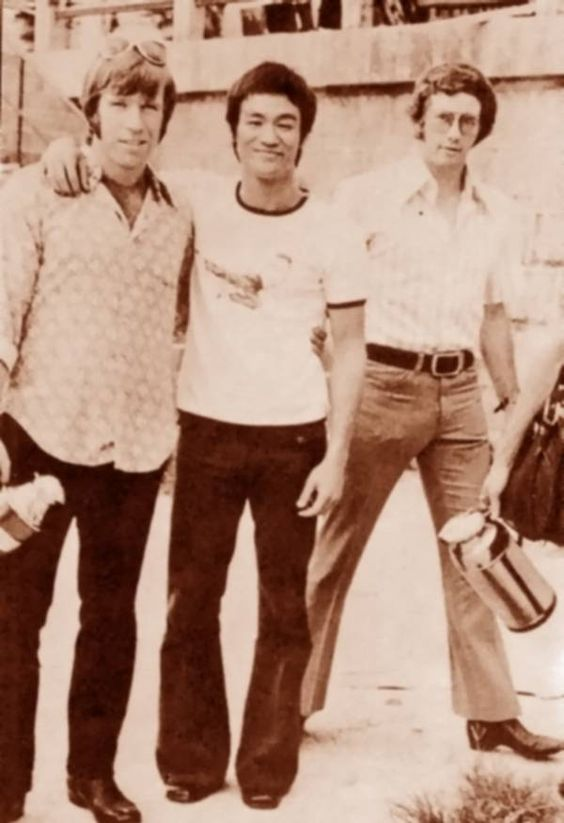
Bruce Lee and Chuck Norris hanging out. Ah, the good old days
Social reengineering did not occur with the ferocity that you see today. No one talked about “Niggers” or “White Privilege”. We just didn’t. At least not in my circles, we didn’t.
Most of that racist bullshit that you read in the media is just made up bullshit.
Instead we talked about television shows, movies, and what we liked or didn’t like about them. We would discuss Charles Bronson (He grew up in Butler, Pennsylvania which was only a half an hour drive from my High School house. ) getting “justice”.
We would talk about Clint Eastwood and his many male-themed movies.
We also didn’t have so much taken out of our paychecks as you kids do today. We had money to spend, and time to enjoy life. We did not need to live in our parent’s basement, and live off them. We worked, even at minimum wage, and could afford our own place and our own car. My generation worked. We earned our place in society.
We paid for our house by saving up for it. We paid for our car by saving up for it. When we were not working, we relaxed.
So what did we do? Why, we “hung out” and “chilled”.
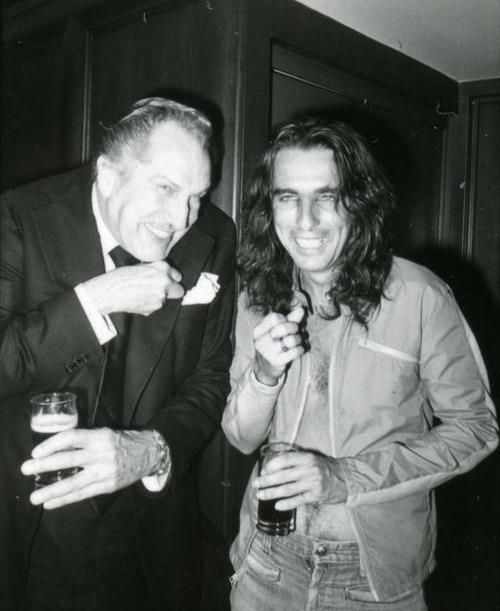
Vincent Price and Alice Cooper Hanging out.
I ask the reader; how about testing your knowledge regarding the time period that I am referring to. Do you know how to develop the film that you took with a 35mm camera?
Have you ever been to a “roller rink”, a “drive-in”, a stainless-steel “diner”, or visited an automat, watched the “evening night news” (this was before the 24-7 all-news networks)? Do you remember a twenty-five cent cup of coffee?
Or, don’t you care, as nothing is better than smashing your piggy bank to buy a cup of Starbucks commercialized beverage?
Oh, and by the way…
“Real” coffee drinkers don’t drink corporate coffee.
Please keep that in mind.
Roller Rink
Having a roller-skating birthday party became something of a rite of passage for American children in the 1950s, 1960s, 1970s and 1980s. Roller rinks in the United States underwent significant changes in the 1970s. New plastics led to improved skate wheels—ones providing a smoother, quieter ride—and easier-to-maintain skate floors.
The Disco craze from popular 1970s culture led to another increase in the popularity of roller rinks—or roller discos, as some became.
Gone were the staid lighting and old-fashioned organ music as a generally older clientele were replaced by adolescents and twenty-something’s skating under mirror balls and special lights to disco beats.
The end of the Disco Era and the advent of inline roller skates hit the roller rink industry hard, with many rinks closing.
Drive In Theater
A drive-in theater is a form of cinema structure consisting of a large outdoor movie screen, a projection booth, a concession stand and a large parking area for automobiles.
Within this enclosed area, customers can view movies from the privacy and comfort of their cars. All teenagers from my generation went to drive-ins on Friday and Saturday nights.
Contrary to popular contemporaneous conventions, we never stayed home and watched television marathons, or surfed the Internet.
A Diner
A diner is a prefabricated fast food restaurant building characteristic of American life, especially in New Jersey, Pennsylvania, New York, and in other areas of the Northeastern United States, as well as in the Midwest, although examples can be found throughout the United States, Canada, and parts of Western Europe.
Diners are characterized by offering a wide range of foods, mostly American, a distinct exterior structure, a casual atmosphere, a counter, and late operating hours.
"Classic American Diners" are often characterized by an exterior layer of stainless steel—a feature unique to diner architecture. Diners share culture with drive ins, and car culture with hot rods and muscle cars.
Diners frequently stay open 24 hours a day, especially in cities, and were once America's most widespread 24-hour public establishments, making them an essential part of urban culture, alongside bars and nightclubs; these two segments of nighttime urban culture often find themselves intertwined, as many diners get a good deal of late-night business from persons departing drinking establishments.
Many diners were also historically placed near factories which operated 24 hours a day, with night shift workers providing a key part of the customer base.
Two Sterling Streamliners remain in operation: the Salem Diner at its original location in Salem, Massachusetts and the Modern Diner in Pawtucket, Rhode Island. I urge the reader to visit a diner. They are still one of my “little” pleasures.
Coffee
Up until 1976, coffee was one of the cheapest food items that Americans could buy. But sometime in the mid seventies, the producers discovered that they could raise the prices of coffee, and that Americans would pay. At that time I worked as a stock clerk in a supermarket, and well remember the price increasing.
First it increased 25%, then another 25%, then doubled. Then doubled again. Americans continued to pay the outrageous prices, because by that time, Americans were addicted to coffee.
Coffee was a staple of the American culture.
Every household had a coffee pot, that sat on the stove and was on all day. Much later, sometime in the 1990’s Starbucks found out just how far one could push the American love of coffee. They created a “coffee lovers” environment, and charged outrageous sums of money for what was nothing more than boiled beans. (Image how much a cup of boiled peas or boiled lima beans would cost. – The actual and real value of the cup of coffee you drink.)
You, my dear readers, are all being taken for a nice long ride by service-to-self individuals and the companies that they surround themselves with.
Indeed, life has changed, and the differences are both subtle and clamorous. This is important for the reader to understand. When I was involved in the MAJestic program, there wasn’t much of an Internet presence.
If you wanted to learn about extraterrestrials or conspiracies, you read the local newspaper, went to the local library, or watched television.
While most people had heard of ET, and UFO’s, their exposure to them was much more difficult to experience. Today, with social media and google-style search engines it is effortless.
But, when I was involved in the program, very few people took the kind of activities that I was involved in seriously. For them, the United States would have never been involved in that kind of activity.

Glass Piggy Bank. I never did need to break it. It was filled with mostly small change. It was easy enough to empty if you just shook it hard enough. In those days, even well into the 1980’s, a dollar could by you’re a Whopper at Burger King.
In fact, I well remember paying a $1 for a Whopper in 2001! (Though that was during a period of “burger wars”.)
We believed in the United States government because we were uninformed, gullible, and saw no need not to. In those days, it was still possible to become a middle class statistic without obtaining a college education. (Indeed the most ridiculous concept in the old 1960’s cartoon “The Jetsons” was the concept that a factory worker could support a middle class lifestyle for a family of four.)
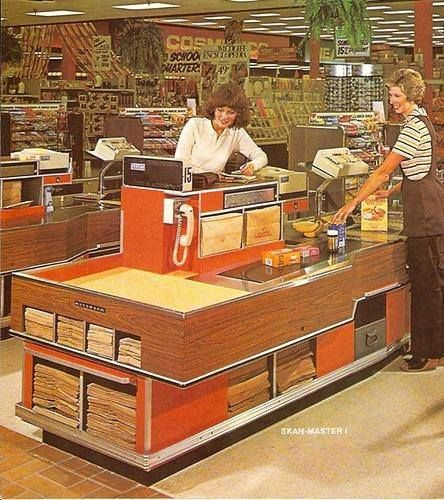
Grocery stores used paper bags. When I wasn’t working in the coalmines, I was a “box boy” at the local supermarket. I would stand there, in my apron and bow tie, at the end of the counter filling the customer bags with their groceries.
What was it like? It was like THIS.
Work was everywhere, and the amount of government intrusion in one’s lives was minuscule compared to what is present today. We believed that the United States was good, righteous and just. (Even after the “Watergate” fiasco.)
We believed that the media would report the truth. (Bwahhhh ha ha ha ha ha…)
We believed that those we voted into office would represent us. (Gosh,…I am now lying on the ground, rolling, and laughing my ass off!!!)
We believed that our tax monies went to “just” purposes. (Oh, stop…stop! This is just too rich!)
That was what we believed! As strange and as unlikely as it might sound today.
Stop buying into the lie that your vote matters.
Your vote doesn’t elect a president. Despite the fact that there are 218 million eligible voters in this country (only half of whom actually vote), it is the electoral college, made up of 538 individuals handpicked by the candidates’ respective parties, that actually selects the next president.
The only thing you’re accomplishing by taking part in the “reassurance ritual” of voting is sustaining the illusion that we have a democratic republic.
What we have is a dictatorship, or as political scientists Martin Gilens and Benjamin Page more accurately term it, we are suffering from an “economic élite domination.”
We were very simplistic.
In every study of events prior to, say the year 2000, one must take into account that communication, activities and behaviors were fundamentally different than they are today. That difference should be recognized and applauded.
Because (as the reader should be well aware by now) we are all connected in a quantum sense. Group thought, amplified by social media, directs our behaviors whether we want to recognize it or not.
That being stated, I enjoy social media as much as the next guy. Tumblr, QQ, WeiXin and Pinterest are my favorites, while fffound comes in a close number three. (Update fffound shut down a few years ago.)
“…a darkened auditorium with 264 silent people in the seats. on the stage, me, sitting on a stool, lit by a spotlight, the only light in the theatre. I hold up a photo of my cat, 10 people applaud, two or three hold up photocopies of the same photo, the rest do nothing, watching, waiting…
Meanwhile a lone masked person in the back heckles me and throws popcorn at the stage.”
-Unknown
I personally love Tumblr, as the quality of the pictures that you can find is outstanding. It is also a great site to find porn.
The problem with this is that you don’t want to see porn all the time, 24-7.
Yet, if you find a porn blog on Tumblr that you like, you will bookmark it and get on it’s feed. As a result it will “pollute” your normal and regular feed.
You will be like other Tumblr users, who when using their computer in public or at work would whisper under their breath “Please don’t be porn. Please don’t be porn.” when checking their Tumblr feed. LOL.
You see, Americans have to pretend that they don’t like porn. We have to pretend that we are disgusted by looking at nude people. Yet the opposite is true. All men enjoy porn. At least soft-porn. Hard core stuff can get too ugly.
And, that is the way it is, and no quasi-religious or SJW revisionist is going to erase that fact. Go explore the rest of the world. The rest of the world doesn’t really care. They DON’T CARE.
Anyways…
Americans have to be careful on how they express themselves on social media. The FBI, CIA, NSA and other government agencies are investing in and relying on corporate surveillance technologies.
These technologies can mine constitutionally-protected speech on social media platforms such as Facebook, Twitter and Instagram.
It is done (supposedly) in order to identify potential extremists and to predict who might engage in future acts of anti-government behavior.
For instance, a decorated Marine, 26-year-old Brandon Raub was targeted by the Secret Service because of his Facebook posts.
As such, he was [1] interrogated by government agents about his views on government corruption, [2] arrested with no warning, [3] labeled mentally ill for subscribing to so-called “conspiratorial” views about the government, [4] detained against his will in a psych ward for having “dangerous” opinions, and [5] isolated from his family, friends and attorneys.
Scant Vacations
OK, I am going to get off in a tangent. (What is this, the sixth tangent off this post? Jeeze!) Sorry folks, but this is important.
OK. The fact is this. If you are an American, you get a pitiful amount of vacation time. While “officially” most Americans are entitled to a minimum of two weeks vacations at “most” companies, it only applies to full-time employees who have worked at least five years.
However, most Americans typically don’t work at a company for more than five years. In fact, for all the positions that I held as a “white collar” engineer and manager, I typically was only given one-week vacation.
In addition, often WHEN I was permitted to take this was mandated during either the Christmas holiday or during the mid-summer plant shutdown. Here’s some great articles and quotes on this…
“Let's be blunt: If you like to take lots of vacation, the United States is not the place to work. Besides a handful of national holidays, the typical American worker bee gets two or three precious weeks off out of a whole year to relax and see the world -- much, much, MUCH less than what people in many other countries receive."
And even that amount of vacation often comes with strings attached.
Some U.S. companies don’t like employees taking off more than one week at a time. Others expect them to be on call or check their e-mail even when they’re lounging on the beach or taking a hike in the mountains.
No legal obligation to offer vacation
So what’s going on here? A big reason for the difference is that paid time off is mandated by law in many parts of the world.
Germany is among more than two dozen industrialized countries — from Australia to Slovenia to Japan — that require employers to offer four weeks or more of paid vacation to their workers, according to a 2009 study by the human resources consulting company Mercer.
Finland, Brazil and France are the champs, guaranteeing six weeks of time off.
But employers in the United States are not obligated under federal law to offer any paid vacation, so about a quarter of all American workers don’t have access to it, government figures show.
That makes the U.S. the only advanced nation in the world that doesn’t guarantee its workers annual leave, according to a report titled “No-Vacation Nation” by the Center for Economic and Policy Research, a liberal policy group.
For what ever it is worth, from 1988 to 2001, while I was employed as an engineer, I took no vacation. While I qualified for two weeks, I was never permitted to take them.
Most U.S. companies, of course, do provide vacation as a way to attract and retain workers.
But the fear of layoffs and the ever-faster pace of work mean many Americans are reluctant to be absent from the office — anxious that they might look like they’re not committed to their job.
Or they worry they won’t be able to cope with the backlog of work waiting for them after a vacation.
Then, there’s the way we work.
Working more makes Americans happier than Europeans, according to a study published recently in the Journal of Happiness Studies.
That may be because Americans believe more than Europeans do that hard work is associated with success, wrote Adam Okulicz-Kozaryn, the study’s author and an assistant professor at the University of Texas at Dallas.
“Americans maximize their… [happiness] by working, and Europeans maximize their [happiness] through leisure,”
So despite research documenting the health and productivity benefits of taking time off, a long vacation can be undesirable, scary, unrealistic or just plain impossible for many U.S. workers.
Maybe a chance for change
A recent report has found that the United States is the only advanced economy that does not require employers to provide paid vacation time.
Almost 1-in-4 Americans do not receive any paid vacation or paid holidays, trailing far behind most of the rest of the world’s rich nations, according to the report.
“No-Vacation Nation Revisited,” released earlier this year by the Center for Economic and Policy Research reviewed the international labor laws impacting paid vacation and holidays in 21 rich nations.
The countries included 16 European countries, Australia, Canada, Japan, New Zealand, and the United States, all major economies that are members of the Organization for Economic Cooperation and Development.
Some highlights of the report:
For the United States:
- Workers have no statutory right to paid vacations.
- The sum of the average paid vacation and paid holidays provided to workers in the private sector ― 16 in total ― would not meet even the minimum required by law in 19 other rich countries, the report notes.
- The lack of paid vacation and paid holidays is particularly acute for low-wage workers, part-time workers, and for employees of small businesses.
(Workers in small businesses are less likely to have any paid vacation (69 percent) than those in medium and large establishments (86 percent); only 49 percent of low-wage workers have paid vacation, compared to 90 percent of high-wage workers; part-time workers are far less likely to have paid vacations (35 percent) than full-time workers (91 percent). - The gap between paid time off in the United States and the rest of the world is even larger when legal holidays are included. U.S. law does not guarantee any paid holidays, but most rich countries provide between 5 and 13 per year, in addition to paid vacation days.
For other rich countries:
- Workers in the European Union are legally guaranteed at least 20 paid vacation days per year, with 25 and even 30 or more days in some countries.
- Canada and Japan guarantee at least 10 days of paid vacation per year.
- Five countries even mandate that employers pay vacationing workers a small premium above their standard pay in order to help with vacation-related expenses.
- Most other rich countries have also established legal rights to paid holidays over and above paid vacation days.
- Several foreign countries offer additional time off for younger and older workers, shift workers, and those engaged in community service including jury duty and for activities like union duties, getting married, or moving.
“The United States is the only advanced economy in the world that does not guarantee its workers paid vacation days and paid holidays,” John Schmitt, senior economist and co-author of the report, said in a statement. “Relying on businesses to voluntarily provide paid leave just hasn’t worked.”
American Average Work Hours:
- At least 134 countries have laws setting the maximum length of the work week; the U.S. does not.
- In the U.S., 85.8 percent of males and 66.5 percent of females work more than 40 hours per week.
- According to the ILO, “Americans work 137 more hours per year than Japanese workers, 260 more hours per year than British workers, and 499 more hours per year than French workers.”
- Using data by the U.S. BLS, the average productivity per American worker has increased 400% since 1950. One way to look at that is that it should only take one-quarter the work hours, or 11 hours per week, to afford the same standard of living as a worker in 1950 (or our standard of living should be 4 times higher). Is that the case? Obviously not.
Someone is profiting, it’s just not the average American worker.
American Paid Vacation Time & Sick Time:
- There is not a federal law requiring paid sick days in the United States.
- The U.S. remains the only industrialized country in the world that has no legally mandated annual leave.
- In every country included except Canada and Japan (and the U.S., which averages 13 days/per year), workers get at least 20 paid vacation days. In France and Finland, they get 30 – an entire month off, paid, every year.
But Hey! It’s the price for living in the BEST nation in the world! Right?
Working in America
Here’s a great write up by Ashley Fern titled “The 8 Reasons You Hate Your Job In Corporate America”. I think it says it all far better than I ever could.
“Corporate America: the place where the majority of post grads will find themselves, for better or for worse (but, for the most part, the worse). There is no college class or prep course that can help you prepare for the reality you are about to embark on for the rest of your life. There’s no smooth transition as you begin your life as a corporate slave.
You go from having the best four years of your life into a world of misery and greed.
There will be highs and lows, ups and downs if you are going to devote yourself to this career path. Sometimes you will love your job but more often than not, this probably will not be the case. It’s hard to find the “right” job when you first exit college. Just because you had a certain major does not guarantee its respective career path will be right for you. Life in the real world versus what you learn in a classroom are two vastly different entities.
Unfortunately in many cases, you will sacrifice your happiness and freedom for a paycheck; you become a slave to “the man”. What are the other complaints about working for corporate America…
No Freedom
The lower you are on the office totem pole, the more people you have to listen to when completing tasks. You have a rigorous schedule filled with tasks that your manager most likely assigned you. You cannot choose which tasks you would like to perform nor which order you want to complete them in as you are most likely taking orders from someone else. Until you run your own company, you are always going to be listening to someone else’s directions.
Office Bitch
For the abuse you take, you don’t make nearly enough money -- especially after taxes. You will take an endless amount of sh*t from upper management that can and will drive you insane.
If your boss is having an off day, guess who is going to feel the worst of it? You are.
You are at the bottom of the barrel and no feelings will be spared since you really do not serve an integral role in the company’s success.
Obsession With Money
You think your first job will be an enlightening experience in which you will finally contribute something meaningful to the world. The problem is that upper management doesn’t want to waste their valuable time on someone that much below them. They would rather focus their attention on whatever task they have on hand.
They don’t care about you, all their focus is on whatever can make them the next dollar. Though they will try to give you the impression that that isn't the case. They might issue you a pen with a logo, or arrange some pizza at a meeting.
People Are Miserable
The majority of people care about one thing about their job and that’s the figure on their paychecks. This is one of the biggest reasons people settle into a career path that makes them miserable. Sure, having the ability to afford luxuries is great, but is it worth your happiness?
Wouldn’t you rather work in an industry that brings you happiness and comfort than work at a career you hate just because you make a lot of money? Of course a paycheck is important, without it you couldn’t live -- but at the end of the day, that paycheck isn’t going to bring you the fulfillment that doing what you love does.
The People You Work With Suck
Chances are you aren’t going to be working with people you would choose to associate with outside the office. Sometimes the person closest to your age is 10 years older than you: #fail. It’s horrible to be stuck inside an office from 9-5 without one person you can talk to. Thank the lord for G-chat.
You’re Bored
The repetitive, mundane life corporate America offers you is not one of excitement. Life is full of surprises and opportunities; this is where happiness will manifest.
You know where it will not flourish?
Within the restraints of a 4×4 cubicle, staring blankly at a computer screen. Routine behavior will numb your mind whereas unpredictability will engage it. “Happiness is a state of activity,” as Aristotle has so famously said.
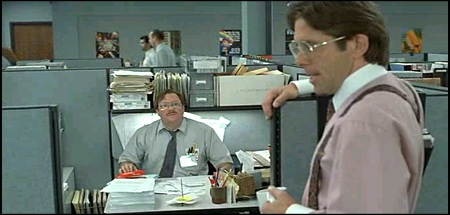
Your corporate life. This is why you obtained a nice four-year college degree.
You Realize This Reality Is A Lie
Unfortunately, as a generation we were raised with the idea that if we go to school, get a typical job and make a lot of money, we will be happy. Happiness should be a reflection of your personal ambition and success, not by what kind of car you have in your driveway. I would rather be struggling to make ends meet, working towards something I love than relishing in money working at a company that makes me miserable.
No Creative Outlet
How can you grow as a person if you are stuck doing the same meaningless tasks on a day-to-day basis? This type of environment will literally suck the soul out of you. Living your life in suspense is exhilarating; variety is what keeps things entertaining and exciting. Spending eight hours trapped in a small space reading over excel spreadsheets is not going to get your creative juices flowing.”
Thank you Ashley Fern.
This is all pretty much well known to those of us who had to sit in those grey boxes and stare at computer screens all day long. We did this with absolute dictatorial watching of office hours and battles over the scant vacation and leave time.
Couple that with the ever present risk of losing your job and you end up with a very, very stressful situation.
This was quite prevalent in the white-collar world during the time when I was employed. We lived the life shown in the movie “Office Space”. It was our reality. Welcome to the life that I lived (in the physical).
Peter Gibbons: You're gonna lay off Samir and Michael?
Bob Slydell: Oh yeah! We're gonna bring in some entry-level graduates, farm some work out to Singapore, that's the usual deal.
Bob Porter: Standard operating procedure.
Peter Gibbons: Do they know this yet?
Bob Slydell: No. No, of course not! We find it's always better to fire people on a Friday. Studies have statistically shown that there's less chance of an incident if you do it at the end of the week.
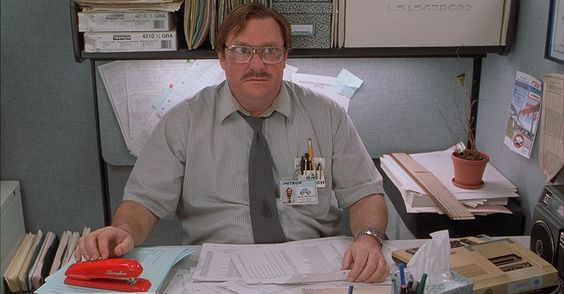
Life as an engineer in 1990’s America. Still from the movie classic “Office Space”. Office Space is a 1999 American comedy film written and directed by Mike Judge.
It satirizes the everyday work life of a typical mid-to-late-1990s software company, focusing on a handful of individuals fed up with their jobs.
There was always some kind of “workplace improvement program” going on. It might be [1] a mandatory blood collection effort (it was, of course they couldn’t say that it was mandatory, that would be against the law… but it was.
We all “knew” the consequences if we did not follow what was asked of us.
The government would make regulations to “protect” workers, and companies would either find ways around them, or simply ignore them.).
Consider my experience with [2] a mandatory weekend cleaning of the offices. (The company fired the janitorial staff, and so we all had to come in over the weekend to clean up.)
Alternatively, it might be [3] two trashcans that we would use to separate our trash into. (An on-going “green” effort that the company was promoting.) One for recyclables, and the other for non-recyclables.
There were fines and punitive measures placed on us if we did not sort through our trash.
Here’s a true, and illustrative, story regarding this particular company initiative.
One night I had to work late. After everyone else had left, I was working at my desk later at night. It was perhaps 7pm. As such, the janitors came in and began cleaning. One of the first things that they did was empty the trash. As I sat there, I watched them empty the trash. What they did was pick up the trash and empty it into a big-wheeled bin. They took the blue color recycle bin and emptied it into a big-wheeled trash hopper. Then they took the “regular” non-recyclable trash and emptied it in the same bin. I watched for a minute or two, and then paused in reflection.
Innocently, I asked the janitor why he didn’t separate the trash, as he was “supposed to”. After all, we were being penalized for not separating the trash. In fact, if you were to report on another coworker (for failing to separate) you would be rewarded with perks; a coupon for a discount coffee or a free movie ticket. And they, as violators, would “suffer” the consequences…
He responded that he didn’t need to.
No one came to collect the sorted trash. No one had set up a system to collect pre-sorted trash. So what they did was just mix it all together. They then would throw it all in the dumpster and it would be picked up by the garbage truck as was. What was going on was an illusion of company participation in a recycling program. However, there really wasn’t any actual effort to recycle the waste.
That was corporate America.